Author: Bryan Bibeau

  • Homemade SOTA battery for the FT-817ND 11.1V 3S1P LiFePO4

    In looking around for a decent battery for SOTA activations on my FT-817ND radio, I decided that nobody was making the exact battery that I wanted. Up until now, I’ve been successfully using a Bescor 4500mAh, 12V NiMH battery. I wanted something that was slightly lighter, and also a lower pack voltage to minimize the standby current on this particular radio.

    I decided on the LiFePO4 (Lithium Iron Phosphate) technology, because it has a lot of the energy characteristics of other Lithium batteries, but with less chance of fire! All my parts were purchased from BatterySpace.com. They shipped pretty quickly and I got exactly what I ordered.

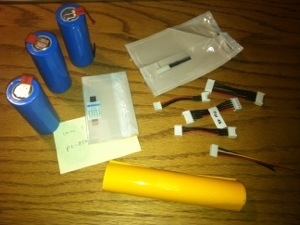
    Here are the parts as they arrived in the mail. (3) 3300 mAh cells, a fusible link, an over temperature link, some heat shrink and a balancing connector.
    20121022-210218.jpg

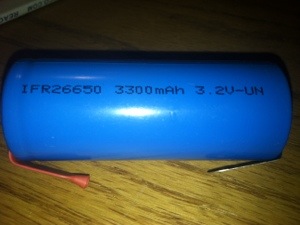
    A shot of the individual cell:

    20121022-210226.jpg

    The over-temperature link. I connected this between cells 2 and 3.
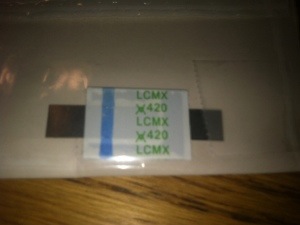
    20121022-210232.jpg

    Here’s a shot of the self-resetting fuse. This was soldered between cell 1 and 2:
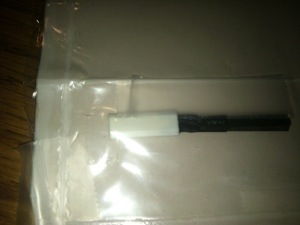
    20121022-210239.jpg

    Before I soldered any of the cells, I hot glued them together. I always used to think hot glue guns were for craft folks. I now find myself using it a lot for fabricating “stuff.”
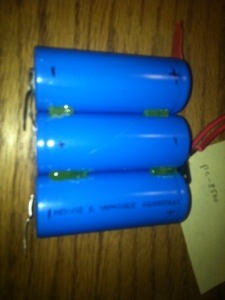
    20121022-210245.jpg

    After shrink tape applied! I put 2 wraps on and alternated them. Once it’s fully tested I’ll put 1 more wrap on just to be safe.
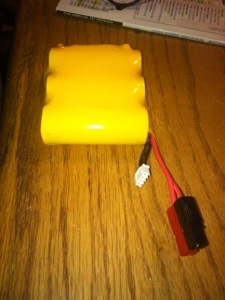
    20121022-210254.jpg

    Here’s the pack connected to the balancing board on my Thunder Power TP610C-ACDC charger. I got this charger a few weeks ago, and it’s the fanciest battery charger I’ve ever had! I’m glad I spent the money on something nice and versatile. I’ve used it for my SLABs, AGMs, NiMH packs and now the LiFePO4 pack.
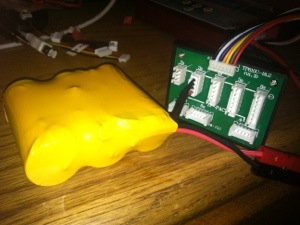
    20121022-210303.jpg

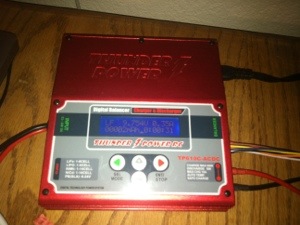
    View of the charger. This one is nice because it can use DC or AC as a source of power for charging. Handy if you’re at home or in the field.
    20121022-210311.jpg

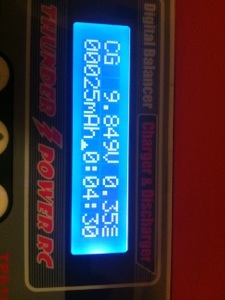
    View of the screen with first charge. The little carrot indicates that the charger is sensing the center taps between cells. BTW, on the balancing wires, connect the red wire to red, black to black. The Green wire, which is adjacent to the red wire on the balancing plug, should connect to the tap between cell 2 and 3. The yellow wire which is next to the black wire, should connect to the tap between cells 1 and 2. To test, measure on the balancing connector. Between black and Yellow, you should measure 1 cells voltage (~ 3.5V). Between black and Green you should measure 2 cells in series, or ~ 7.0VDC. Between black and red, you should have the full pack voltage of ~ 9-10VDC. The cell voltages will depend on the state of charge that the batteries arrived in.

    Keep an eye on this battery during the first few charge/discharge cycles. It should be perfectly safe, but it’s better to keep an eye on things.
    20121022-210326.jpg

  • 2m ssb using a FT-817ND

    Made my first 2m ssb contact tonight from Fort Collins to Eaton on 5W using my FT-817nd and Arrow 146-4BP. Fun!

    20121001-193943.jpg

    20121001-194001.jpg

  • New battery charger

    I have a 12v / 4500mAh battery that I’ve been using with my FT-817nd. It is NiMH technology and is lighter than a comparable SLA battery. The problem has been charging, since I only had a SLA charger. Today I picked up a Thunder Power TP610C-ACDC charger from Hobbytown that can charge LiPo, LiFePO4 (and other lithium types), NiMH, NiCad, Lead acid and maybe others. It has some really nice features. I’m planning to also put together a Li-ion pack using surplus camera batteries, so I wanted a versatile charger.

    20120929-191133.jpg

  • Gulf Hagas

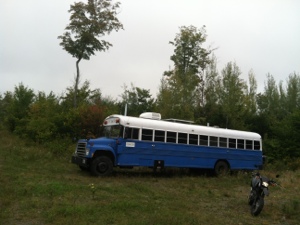
    Paul and I took the Blue Bird of Happiness to Gulf Hagas this year for the annual bus trip. We had trouble at the gate. They told us we were too big for the active logging road. Our solution? The moto! Nope, that’s too small she exclaimed.

    20120923-080834.jpg
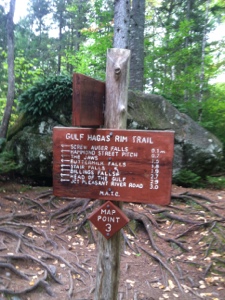
    So, we found a camping spot out an unused logging road. The next day we searched for a secret road into Gulf Hagas on the moto, but found it does not exist. We hitched a ride from the gate.

    20120923-081056.jpg

    20120923-081121.jpg

    20120923-081140.jpg
    There are more photos at Smugmug!

  • 2 meter dipole with Buddistick vertical

    Tonight I decided to play around with my Buddistick vertical setup to see if I could make a 2m dipole for ssb contacts. I drilled and tapped a piece of 1/8″ aluminum flatbar and used it to mount my 2nd adjustable whip. I could actually hear some of the Monday night RMVHF+ Net from outside the house, but it was really faint. I flipped it vertical and keyed up a local repeater. I’ll try this again on an upcoming SOTA trip. I plan to ultimately build up or buy a portable 2m/70cm Yagi for this work. This setup will be nice if it works since I’m not carrying anything extra with me.

    20120820-203736.jpg

    20120820-203742.jpg

  • SOTA alerts for this weekend

    I’m planning to do 3 SOTA summits this weekend while we’re camping up on Independence Pass between Leadville and Aspen. Hopefully in the following order:

    Saturday 8/18/2012 at 10:00 local Mountain time: W0/SR-108 using QRP 14.343 SSB and 146.52FM
    Saturday 8/18/2012 at 14:00 local Mountain time: W0/SR-115 using QRP 14.343 SSB and 146.52FM
    Sunday 8/19/2012 at 10:00 local Mountain time: W0/SR-020 using QRP 14.343 SSB and 146.52FM

    I’ll have my TH-D72A beaconing to

    I’m trying to pick up an Arrow Yagi for 2m. If I have that in time, I’ll try both FM and SSB on 2m.

  • Yaesu FT-817ND with Buddistick vertical

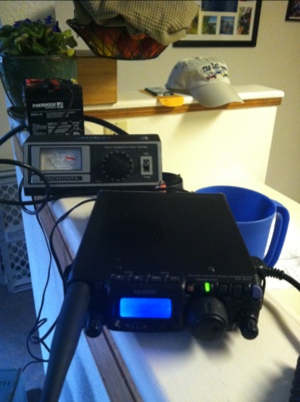
    Made big headway today with my new setup. I had only made one contact so far and was getting frustrated. The SWR meter on my 817 showed nothing so I assumed everything was tuned correctly. I finally hooked up my old Micronta 21-525B gifted to me by K1LQH, and found my SWR on CW was 3:1! I shortened the whip about 12″ and immediately was copied 5-9 by a station in CT and another in MD!

    20120811-205941.jpg

  • 10 meter antenna part II

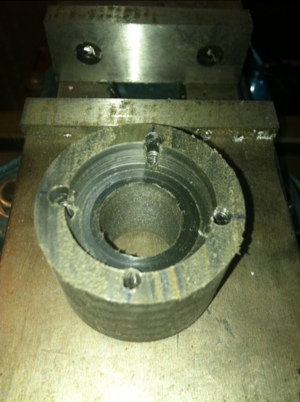
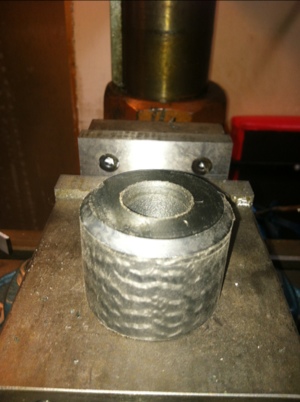
    I used Nylon rod turned on my lathe to mount the mast to the ground plate. I may switch to fiberglass later, but cheap is my goal and I had the Nylon and PVC pipe for the vertical. I used 14 gauge Romex stripped out for the conductors. At the top of the PVC I’ll add a plastic compression fitting to seal the copper that extends just beyond the pipe.

    20120729-190525.jpg

    20120729-190535.jpg

    20120729-190545.jpg

  • Homebrew 10 meter vertical

    I’m working on a 10 meter vertical antenna for the roof of my house. It’s a quarter wave ground plane centered on 28.8 MHz, so it will be 97.5″ tall with 4 97.5″ radials. I used the formula Length of Dipole (feet) = 468 / Frequency (MHz). Since the radials comprise one half of the dipole and the vertical is the other half, you divide the length by 2.
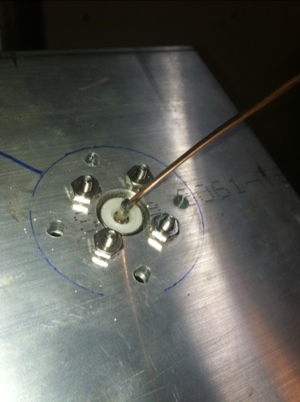
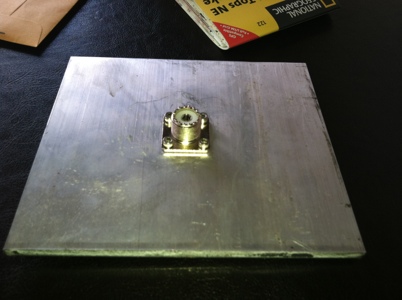
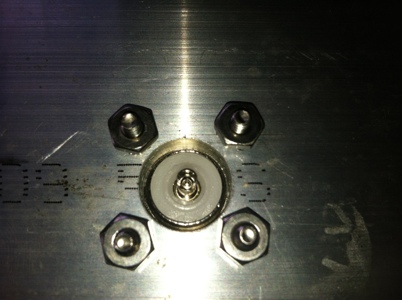
    I’m looking for some 1/4″ diameter fiberglass rod for the vertical. We get a lot of wind in Colorado so it needs to be tough. The base is a 1/4″ thick aluminum plate with a SO-239 bulkhead connector. I will weld on a round piece of stock on the top side, then turn it on my lathe as a receiver for the fiberglass rod. A length of 14 gauge stranded copper will live inside the fiberglass tube.
    Here are some pictures of the base that I started on today:

    20120729-145340.jpg

    20120729-145351.jpg